

Disclaimer: This page contains affiliate links. If you choose to purchase through them, I may earn a small commission at no additional cost to you. I only recommend products I personally use and that have earned their place in my workflow. As an Amazon Associate, I earn from qualifying purchases. Please see my disclaimer for more. For information on how I research and test products and how I use AI in my content, see my editorial guidelines.
Are you frustrated because your bread loaves turn out too short, too dense, or your quick breads spill over in the oven?
It might not be your recipe.
It might be your loaf pan.
What I didn’t understand for years is that loaf pans aren’t only defined by their shape. They’re defined by how much they hold. Small differences in pan size can change your results more than you might expect.
Before you change your recipe, check whether your pan actually fits what you are baking.
Loaf Pan Size Cheat Sheet: Start With the Baking Job
The fastest way to choose a loaf pan is to match the pan size to the job it needs to do. A sandwich loaf, quick bread, Pullman loaf, and mini loaf all need different things from the pan.
| Baking Job | Best Pan Size | Why It Works | Watch For |
|---|---|---|---|
| 1 lb sandwich loaf | 8.5 x 4.5 inch loaf pan | Helps dough rise up instead of spreading wide. | A 9 x 5 pan may create a squat loaf. |
| 1.25 lb loaf or larger sandwich loaf | 9 x 5 inch loaf pan | Gives larger dough room to rise. | Too little dough may bake flat. |
| Quick breads | 9 x 5 inch loaf pan | Leaves room for batter expansion. | Smaller pans may overflow or underbake. |
| Fresh milled flour sandwich bread | 8.5 x 4.5 inch pan | Pan shape and dough amount matter more. | Test dough weight, hydration, and rise. |
| Pullman sandwich bread | 9 x 4 x 4 inch Pullman pan | Creates straighter sides and square slices. | Too much dough can hit the lid. |
| Large Pullman loaf | 13 x 4 x 4 inch Pullman pan | Works for larger dough batches. | Too large for most small-batch recipes. |
| Mini loaves | Mini loaf pans | Good for gifts, tests, and small portions. | Sizes can vary and bake times may need adjusted. |
The simple rule
The simple rule: choose a loaf pan by the baking job, dough or batter amount, pan dimensions, and pan volume, not by the vague label on the package.
A “loaf pan” can mean several different things. That is why one pan gives you a tall sandwich loaf and another gives you a short, squat loaf even when the recipe did not change.
The chart gives you the starting point. The details below explain why loaf pan size matters, how common pan sizes compare, and how to choose the right pan for sandwich bread, quick breads, Pullman loaves, fresh milled flour bread, and smaller baking projects.
The Hidden Problem: I Thought A Loaf Pan Was Just A Loaf Pan
I assumed (wrongly) that a loaf pan was a loaf pan. That one brand’s version was not significantly different than another.
I first attempted to solve my problems by switching to recipes using gram measurements. The experienced bakers I turned to all did this. But I still had the same problems.
My next attempt at a solution was to buy a better quality pan. I didn’t like the nonstick materials and the experienced bakers I watched didn’t use them.
My research led me to USA pans. Creators I viewed as valuable mentors raved about them. And I preferred their coatings.
I chose their beginner friendly pan – the ABC 1 lb loaf pan.
I had no idea what 1 lb loaf pan meant and I certainly didn’t notice the actual dimensions. I still believed that a loaf pan was just a loaf pan.
I wasn’t thinking about how much dough that pan was actually designed to hold.
I kept trying different recipes until I found one that gave me the best results. I assumed I had been using the wrong recipes. I still wasn’t thinking about pan size at all.
As I have gotten further into my fresh milled flour journey, I really started focusing on fine tuning my results. I didn’t like the rounded corners the ABC pan gave my bread. I wanted the sharp corners I saw from others’ recipes.
I turned to my favorite USA brand. I saw they had 1 lb, 1.25 lb, and 1.5 lb pan sizes. I purchased the 1 lb size but it got me thinking about why there were other sizes.
And that finally led to me understanding that all those loaf pans that seemed so similar in size really aren’t. It is all about volume.
The volume of the 1.25 lb pan is 18% larger than the 1 lb pan. That is significant. And I had missed it all these years.
That difference means the same dough behaves completely differently in each pan. Even though nothing about the recipe changed.
In the larger pan, the dough spreads out further horizontally than vertically. It can struggle to rise tall.
In the smaller pan, the dough spreads out further vertically than horizontally. It can have nowhere to go except to spill over.
Why Grams Didn’t Solve My Problems
I initially thought my problems were cause by inaccurate measurements. So many experienced bakers used grams to be precise. So I bought a scale and started baking using grams.
And I still had problems.
I can make the most precisely weighed dough but if I don’t put it in the right environment, my results will still be off.
The recipe tells you what you are making. The pan size determines what it will become.
Different types of recipes have different pan needs:
- Bread dough expands into the space you give it
- Batter recipes fill the pan
Once I started to understand how the pan size impacts my results, all my problems and failed solutions started to make sense.
Every problem came back to 3 basic variables.
The Simple Pan Sizing System
In the most basic terms, the system has 3 variables:
- Dough Weight
- Pan Volume
- Pan Fill Level
If the interaction between these variables isn’t correct, your results will be off. This is true even if everything else in your recipe is correct. The most exactly measured ingredients can have problems in the wrong pan volume and fill level.
Loaf Pan Dough Weight and Fill General Guide
8.5″ x 4.5″
1 lb Loaf Pan
Dough Weight
650 – 750g
AP Flour
300 – 420g
~ 2.5 – 3.5 cups
Fill level → 1/2 – 2/3 full
Rise above lip → Yes
9″ x 5″
1.25 lb Loaf Pan
Dough Weight
750 – 900g
AP Flour
360 – 480g
~ 3 – 4 cups
Fill level → 1/2 – 2/3 full
Rise above lip → Yes
10″ x 5″
1.5 lb Loaf Pan
Dough Weight
900 – 1000g
AP Flour
420g – 600g
~ 3.5 – 5 cups
Fill level → 1/2 – 2/3 full
Rise above lip → Yes
Note: These general ranges are for standard AP flour yeast bread doughs. Enriched doughs (milk bread, brioche, etc), high-hydration doughs, and whole grain doughs will fall outside these ranges. For quick breads and batter-based loaves (banana bread, zucchini bread, pound cake), fill the same pans ½ to ¾ full by volume. Batter does not behave like dough and these weight ranges do not apply.
Tip: Bread grows into the pan; Batter fills the pan.
The “1 lb” label is a pan-size category; a recipe that specifies a 1 lb pan may not weigh 1 lb exactly. Dough weight varies by recipe, hydration, flour type, and how much rise the bread needs.
Pans That Earned Their Place in My Kitchen
(Disclaimer: links below are affiliate links)
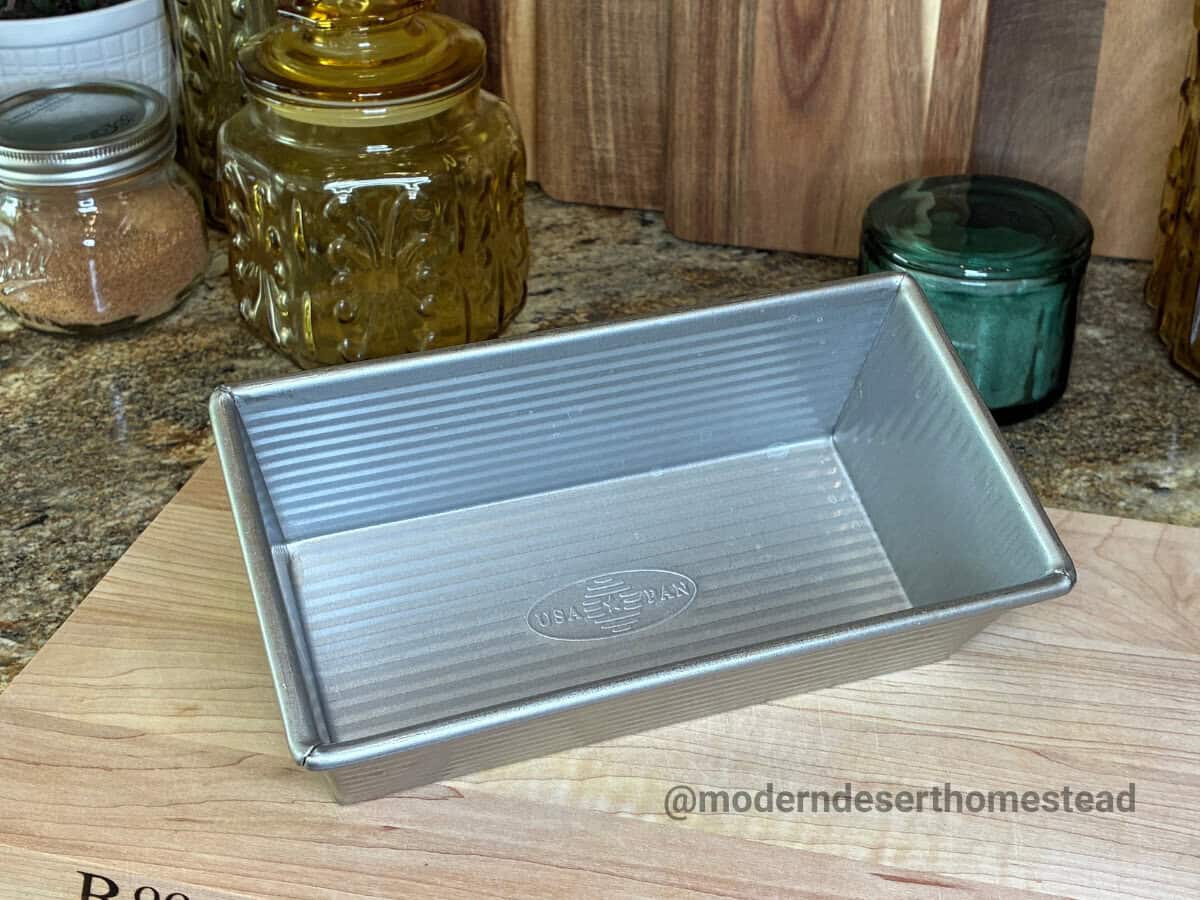
USA Pan 1 lb Loaf Pan
What I use when a recipe calls for a true 1 lb loaf or 8.5″ × 4.5″ pan.
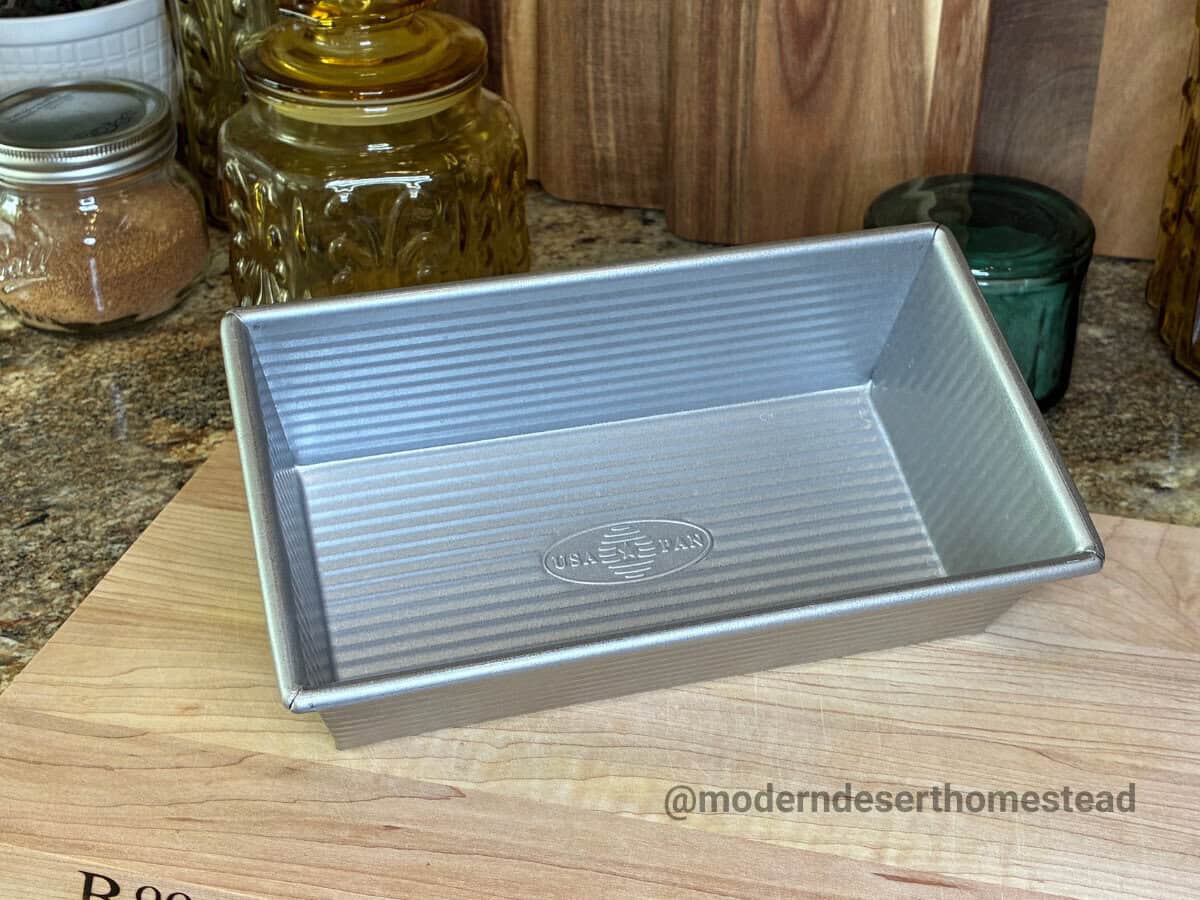
USA Pan 1.25 lb Loaf Pan
What I use when a recipe calls for a true 1.25 lb loaf or 9″ × 5″ pan.
Quick Diagnosis: Problems Your Pan Could Be Causing
If your results aren’t consistent, here are a few signs your pan might be part of the problem:
Short or Squat Loaf
- What You See:
Your bread bakes wide and low instead of rising tall - What It Usually Means:
The pan is too large for the quantity of dough
Overflowing Batter Breads
- What You See:
Batter spills over the edge and makes a mess in your oven - What It Usually Means:
The pan is too small for the quantity of batter
Mushroom Top or Uneven Shape
- What You See:
The top of the bread expands over the edges or looks unbalanced - What It Usually Means:
The dough has more volume than the pan can support
Inconsistent Results Among Recipes
- What You See:
One recipe works and another doesn’t – even when you are carefully following each recipe - What It Usually Means:
The recipes are designed for different pan sizes
For a long time I thought my baking problems were all coming from me or my recipes.
Once I understood how pan size affects recipes, the patterns I was seeing finally made sense.
Before you try changing your recipe, take a look at the pan you used and ask if it actually fits the recipe.
That small detail can make more difference than you expect.

